piątek, 18 stycznia 2008

Mathematical description of waves

From mathematical point of view most primitive (or fundamental) wave is harmonic (sinusoidal) wave which is described by the equation f(x,t) = Asin(ωtkx)), where A is the amplitude of a wave - a measure of the maximum disturbance in the medium during one wave cycle (the maximum distance from the highest point of the crest to the equilibrium). In the illustration to the right, this is the maximum vertical distance between the baseline and the wave. The units of the amplitude depend on the type of wave — waves on a string have an amplitude expressed as a distance (meters), sound waves as pressure (pascals) and electromagnetic waves as the amplitude of the electric field (volts/meter). The amplitude may be constant (in which case the wave is a c.w. or continuous wave), or may vary with time and/or position. The form of the variation of amplitude is called the envelope of the wave.

The wavelength (denoted as λ) is the distance between two sequential crests (or troughs). This generally has the unit of meters; it is also commonly measured in nanometers for the optical part of the electromagnetic spectrum.

A wavenumber k can be associated with the wavelength by the relation

k = \frac{2 \pi}{\lambda}. \,


The period T is the time for one complete cycle for an oscillation of a wave. The frequency f (also frequently denoted as ν) is how many periods per unit time (for example one second) and is measured in hertz. These are related by:
f=\frac{1}{T}. \,

In other words, the frequency and period of a wave are reciprocals of each other.

The angular frequency ω represents the frequency in terms of radians per second. It is related to the frequency by

\omega = 2 \pi f = \frac{2 \pi}{T}. \,

There are two velocities that are associated with waves. The first is the phase velocity, which gives the rate at which the wave propagates, is given by

v_p = \frac{\omega}{k} = {\lambda}f.

The second is the group velocity, which gives the velocity at which variations in the shape of the wave's amplitude propagate through space. This is the rate at which information can be transmitted by the wave. It is given by

v_g = \frac{\partial \omega}{\partial k}. \,

The wave equation

Main article: Wave equation

The wave equation is a differential equation that describes the evolution of a harmonic wave over time. The equation has slightly different forms depending on how the wave is transmitted, and the medium it is traveling through. Considering a one-dimensional wave that is travelling down a rope along the x-axis with velocity v and amplitude u (which generally depends on both x and t), the wave equation is
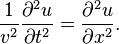
\frac{1}{v^2}\frac{\partial^2 u}{\partial t^2}=\frac{\partial^2 u}{\partial x^2}. \,

In three dimensions, this becomes

\frac{1}{v^2}\frac{\partial^2 u}{\partial t^2} = \nabla^2 u. \,

where \nabla^2 is the Laplacian.

The velocity v will depend on both the type of wave and the medium through which it is being transmitted.

A general solution for the wave equation in one dimension was given by d'Alembert. It is

u(x,t)=F(x-vt)+G(x+vt). \,

This can be viewed as two pulses travelling down the rope in opposite directions; F in the +x direction, and G in the −x direction. If we substitute for x above, replacing it with directions x, y, z, we then can describe a wave propagating in three dimensions.

The Schrödinger equation describes the wave-like behaviour of particles in quantum mechanics. Solutions of this equation are wave functions which can be used to describe the probability density of a particle. Quantum mechanics also describes particle properties that other waves, such as light and sound, have on the atomic scale and below.

Waves can be represented by simple harmonic motion.

Traveling waves

Simple wave or traveling wave, also sometimes called progressive wave is a disturbance that varies both with time t and distance z in the following way:

y(z,t) = A(z, t)\sin (kz - \omega t + \phi), \,

where A(z,t) is the amplitude envelope of the wave, k is the wave number and φ is the phase. The phase velocity vp of this wave is given by

v_p = \frac{\omega}{k}= \lambda f, \,

where λ is the wavelength of the wave.

Standing wave

Main article: standing wave
Standing wave in stationary medium. The red dots represent the wave nodes

A standing wave, also known as a stationary wave, is a wave that remains in a constant position. This phenomenon can occur because the medium is moving in the opposite direction to the wave, or it can arise in a stationary medium as a result of interference between two waves traveling in opposite directions.

The sum of two counter-propagating waves (of equal amplitude and frequency) creates a standing wave. Standing waves commonly arise when a boundary blocks further propagation of the wave, thus causing wave reflection, and therefore introducing a counter-propagating wave. For example when a violin string is displaced, longitudinal waves propagate out to where the string is held in place at the bridge and the "nut", where upon the waves are reflected back. The two opposed waves each cancel the wave propagation of the other. This effect is known as waves. There is no net propagation of energy.

Also see: Acoustic resonance, Helmholtz resonator, and organ pipe

Propagation through strings

The speed of a wave traveling along a vibrating string (v) is directly proportional to the square root of the tension (T) over the linear density (μ):

v=\sqrt{\frac{T}{\mu}}. \,


Equipment for dealing with sound

Equipment for generating or using sound includes musical instruments, hearing aids, sonar systems and sound reproduction and broadcasting equipment. Many of these use electro-acoustic transducers such as microphones and loudspeakers.

Sound pressure level

Sound pressure is defined as the difference between the actual pressure (at a given point and a given time) in the medium and the average, or equilibrium, pressure of the medium at that location. A square of this difference (i.e. a square of the deviation from the equilibrium pressure) is usually averaged over time and/or space, and a square root of such average is taken to obtain a root mean square (RMS) value. For example, 1 Pa RMS sound pressure in atmospheric air implies that the actual pressure in the sound wave oscillates between (1 atm -\sqrt{2} Pa) and (1 atm +\sqrt{2} Pa), that is between 101323.6 and 101326.4 Pa. Such a tiny (relative to atmospheric) variation in air pressure at an audio frequency will be perceived as quite a deafening sound, and can cause hearing damage, according to the table below.

As the human ear can detect sounds with a very wide range of amplitudes, sound pressure is often measured as a level on a logarithmic decibel scale. The sound pressure level (SPL) or Lp is defined as

L_\mathrm{p}=10\, \log_{10}\left(\frac{{p}^2}{{p_\mathrm{ref}}^2}\right) =20\, \log_{10}\left(\frac{p}{p_\mathrm{ref}}\right)\mbox{ dB}
where p is the root-mean-square sound pressure and pref is a reference sound pressure. Commonly used reference sound pressures, defined in the standard ANSI S1.1-1994, are 20 µPa in air and 1 µPa in water. Without a specified reference sound pressure, a value expressed in decibels cannot represent a sound pressure level.

Since the human ear does not have a flat spectral response, sound pressures are often frequency weighted so that the measured level will match perceived levels more closely. The International Electrotechnical Commission (IEC) has defined several weighting schemes. A-weighting attempts to match the response of the human ear to noise and A-weighted sound pressure levels are labeled dBA. C-weighting is used to measure peak levels.

Speed of sound

The speed of sound depends on the medium through which the waves are passing, and is often quoted as a fundamental property of the material. In general, the speed of sound is proportional to the square root of the ratio of the elastic modulus (stiffness) of the medium to its density. Those physical properties and the speed of sound change with ambient conditions. For example, the speed of sound in gases depends on temperature. In air at sea level, the speed of sound is approximately 343 m/s, in water 1482 m/s (both at 20 °C, or 68 °F), and in steel about 5960 m/s.The speed of sound is also slightly sensitive (a second-order effect) to the sound amplitude, which means that there are nonlinear propagation effects, such as the production of harmonics and mixed tones not present in the original sound (see parametric array).

Sound

For humans, hearing is limited to frequencies between about 20 Hz and 20000 Hz, with the upper limit generally decreasing with age. Other species may have a different range of hearing. As a signal perceived by one of the major senses, sound is used by many species for detecting danger, navigation, predation, and communication. In Earth's atmosphere, water, and soil virtually any physical phenomenon, such as fire, rain, wind, surf, or earthquake, produces (and is characterized by) its unique sounds. Many species, such as frogs, birds, marine and terrestrial mammals, have also developed special organs to produce sound. In some species these became highly evolved to produce song and (in humans) speech. Furthermore, humans have developed culture and technology (such as music, telephony and radio) that allows them to generate, record, transmit, and broadcast sounds.

The mechanical vibrations that can be interpreted as sound can travel through all forms of matter: gases, liquids, solids, and plasmas. However, sound cannot propagate through vacuum. The matter that supports the sound is called the medium. Sound is transmitted through gases, plasma, and liquids as longitudinal waves, also called compression waves. Through solids, however, it can be transmitted as both longitudinal and transverse waves. Sound is further characterized by the generic properties of waves, which are frequency, wavelength, period, amplitude, intensity, speed, and direction (sometimes speed and direction are combined as a velocity vector, or wavelength and direction are combined as a wave vector). Transverse waves, also known as shear waves, have an additional property of polarization. Sound characteristics can depend on the type of sound waves (longitudinal versus transverse) as well as on the physical properties of the transmission medium.

Sound propagates as waves of alternating pressure deviations from the equilibrium pressure (or, for transverse waves in solids, as waves of alternating shear stress), causing local regions of compression and rarefaction. Matter in the medium is periodically displaced by the wave, and thus oscillates. The energy carried by the sound wave is split equally between the potential energy of the extra compression of the matter and the kinetic energy of the oscillations of the medium. The scientific study of the propagation, absorption, and reflection of sound waves is called acoustics.

Noise is often used to refer to an unwanted sound. In science and engineering, noise is an undesirable component that obscures a wanted signal.